Still Running Your SQDC Board on a Whiteboard? Here's What It's Actually Costing You
Most manufacturing floors still run daily management on a whiteboard. Here's what that costs in missed patterns, and what a digital SQDC board changes.
Walk onto almost any shop floor in America and you'll find the same thing: a whiteboard, some dry-erase markers in three colors, and a grid of numbers that somebody updates when they remember to.
It's not a bad system. It's just an incomplete one. And the gap between what it's supposed to do and what it actually does is where a lot of manufacturing problems quietly compound.
What the whiteboard is supposed to do
SQDC boards exist for a simple reason: Safety, Quality, Delivery, and Cost are the four things that determine whether a shift went well, and a team that looks at them together, every day, catches problems before they become expensive. That's the whole idea behind daily management. It's a good idea. It's why the practice has survived decades of manufacturing trends.
What actually happens
The whiteboard gets updated when someone has time, which on a busy day is never. Numbers from three days ago are still up because nobody erased them. The person who could explain why Tuesday's quality number tanked has since gone home, and by the time the weekly meeting rolls around, nobody remembers the details well enough to actually fix the root cause; they just note it happened and move on.
Hour-by-hour tracking, arguably the highest-leverage habit in daily management, is usually the first thing to get skipped, because it takes discipline to update a board every sixty minutes, and discipline is the first casualty of a busy shift.
And the problem-solving side, the 3C or A3 process that's supposed to turn a recurring issue into a fixed one, often lives in someone's notebook, or nowhere at all. Which means the same issue quietly comes back next month, and the month after.
The real cost isn't the whiteboard. It's what doesn't get caught.
None of this is because the team doesn't care. It's because a whiteboard has no memory and no way to connect this week's quality miss to the one from six weeks ago that had the same root cause. Every insight lives in someone's head until that person is out sick, or leaves, or just forgets.
The expensive failures in manufacturing are rarely the ones nobody saw coming. They're the ones that showed up as a small deviation weeks earlier, got noted on a whiteboard, and then got erased.
What a digital board actually changes
This isn't an argument for more software for software's sake. It's specifically about the three things a whiteboard structurally can't do:
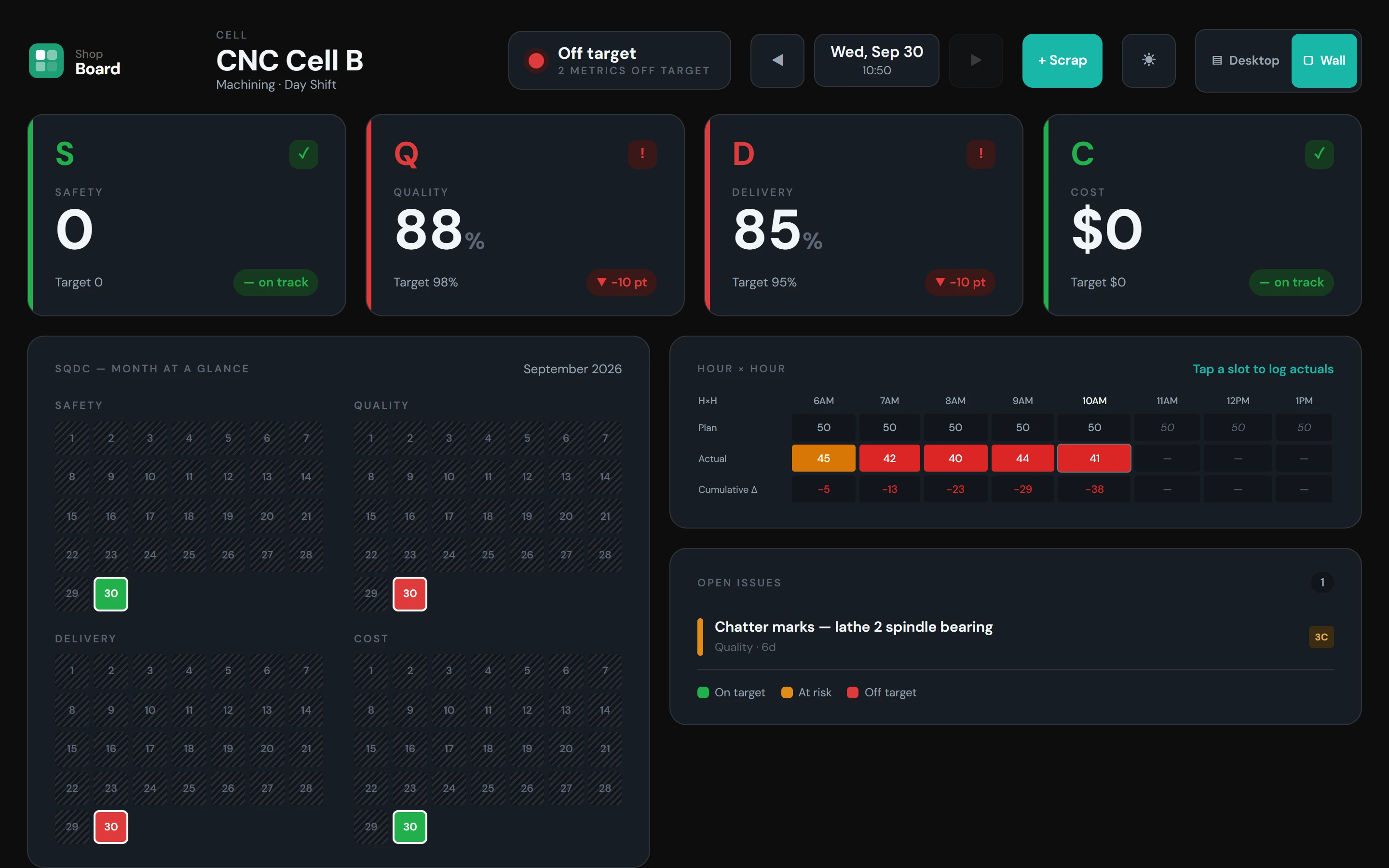
It remembers. Every SQDC entry, every 3C, every A3 stays on file and can be pulled up by cell, category and status, so "didn't we see this before?" has an actual answer instead of a shrug.
It does the math for you. Someone still types the hour, but it's one number, and the running gap adds itself up. Hour-by-hour tracking that takes 90 seconds at the cell is a habit that survives a busy shift, because it's built into the workflow instead of competing with it.
It turns a red box into a fix with a name on it. Log an issue right from the red box and the cell, date and letter are already filled in. A supervisor works it up as a 3C while the details are still fresh, not from memory a week later. Save the 3C with a due date and the countermeasure goes on the Actions list, assigned to a person.
For the full side-by-side, including where a whiteboard still does the job, see whiteboard vs digital board.
Where this comes from
I run operations at a manufacturing facility. I built ShopBoard because I got tired of watching good teams lose good insights to a whiteboard that couldn't keep up with them. It's not a theory for me, it's the Tuesday-afternoon problem I was trying to solve for my own shop.
If any of this sounds familiar, you can see it running on sample data, no signup required: Try the live demo →